123-456-7890

in partnership with


The
BUSINESS OF GUITAR & AMP REPAIR TECHNICIANS
B.O.G.A.R.T.
Evidence-Based information exchange
luthier & tech subculture
I can't tell you the number of times I've heard people ask "What are the best locking tuners to buy? My guitar is always going out of tune! Those folks are typically new to the guitar maintenance arena and haven't learned some of the nuances the more experienced owners have acquired.
Yet in most responses to the question, many, many people convey their learned wisdom of which locking tuners are the best. Locking tuners don't allow the string to move beyond the point in which they are locked. That's it. They don't fix a nut issue, or a saddle issue, or any issue other than the string stretching while wrapped on the post.
Don't get me wrong - locking tuners have their place in this wild guitar world. But it's my opinion that if you buy locking tuners to fix a tuning stability issue that doesn't exist, there are other methods that work just as well.
If there are tuning stability issues, it's best to start with how you wrap your string around the post during a re-string. Too many wraps, in theory, leaves too much string for something to go wrong - like stretch. We all know that new strings need some time to settle (stretch) before they become reliably stable (fewer tuning touch ups). It's my opinion that the entire length of the string - to include that which is wrapped around the post - is a part of the stretching equation.
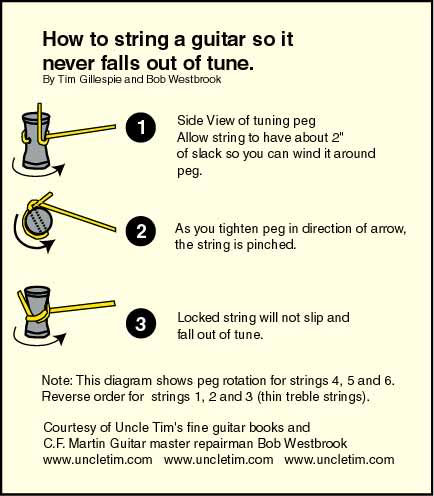
The borrowed diagram on the left here proposes a locking method that I've deployed for a decade. I learned it from an old codger when I lived in the Tidewater area - not a luthier, just a fellow guitar player. This image conveys the technique precisely. You can see that the string - once wrapped as illustrated - becomes locked onto itself. I typically go one more wrap after the lock. I hope you can follow it and employ this method for your own use.